What I just learned about Online Privacy
If you’re anything like me, a mom juggling school drop-offs, packed lunches, life, and the occasional TikTok scroll, you probably think you’ve got a decent handle on online safety. I mean, I don’t click sketchy links. I change my passwords regularly (which I thought I was supposed to), and if a site has that little padlock and says HTTPS, I feel pretty good about shopping there.
Weyullll…turns out, I’ve been wrong about a lot of that.
A Giant Study Just Busted a Bunch of My Privacy Beliefs
I just read a massive global survey (over 12,000 people in 12 countries) all about how regular people like us understand (or misunderstand) online security and privacy. And guess what? Moms in Mexico, dads in Germany, teenagers in India…we’re all pretty confused.
The study looked at things like password safety, public Wifi risks, VPNs and encryption, malware myths, and private browsing mode. My biggest takeaway was that most of us are pretty unsure about a lot of it.
Top Misconceptions (That I’ve 100% Believed)
Here are a few of the myths the study found a lot of people believe:
“Change your password regularly to stay safe.”
Nope. Apparently, constantly changing your password just makes it more likely you’ll use weaker ones or repeat them. Experts now say: only change it if it’s been compromised.
“HTTPS means the website is legit and safe.”
Wrong again. It ONLY means the connection is secure. Even scammy sites can have HTTPS. So don’t enter your credit card info just because you see that lock icon.
“Clicking a random link will infect your computer.”
In most cases, unless you’re in a spy movie, that link won’t do anything unless you download and open something sketchy. But it’s still smart to be cautious.
What Surprised Me Most
Want to hear something wild? People with tech jobs were MORE likely to believe some of these myths. Also, people who actively look up security info online were more confused than those who didn’t. Maybe because there’s just too much conflicting advice out there. Raise your hand if you’ve ever fallen down a Google rabbit hole. (I’m raising my hand.)
On the other hand, people who had actually experienced a cybercrime (like getting hacked) tended to know more.
Moms, Here’s What We Can Do
This study showed that even though most of us aren’t walking around with tinfoil hats, we do care about our privacy. We want to protect our kids’ photos, our banking info, and our peace of mind.
Here’s what I’m taking away from it:
- Stop blindly trusting “old advice.” If it sounds outdated (like changing passwords monthly), it probably is.
- Learn the difference between encryption and authentication. (I had no idea I was mixing those up)
- Teach our kids early. Even my second grader is learning on a tablet. They should know that just because a website looks safe doesn’t mean it is.
Final Thought from One Tired, Tech-Trying Mom
We don’t have to be cybersecurity experts to be safe online, but we do need better information. This global study made me realize that confusion is common, but that doesn’t mean we can’t be smart about how we protect our families.
Check out the full study if you’re interested at:
https://dl.acm.org/doi/full/10.1145/3544548.3581410
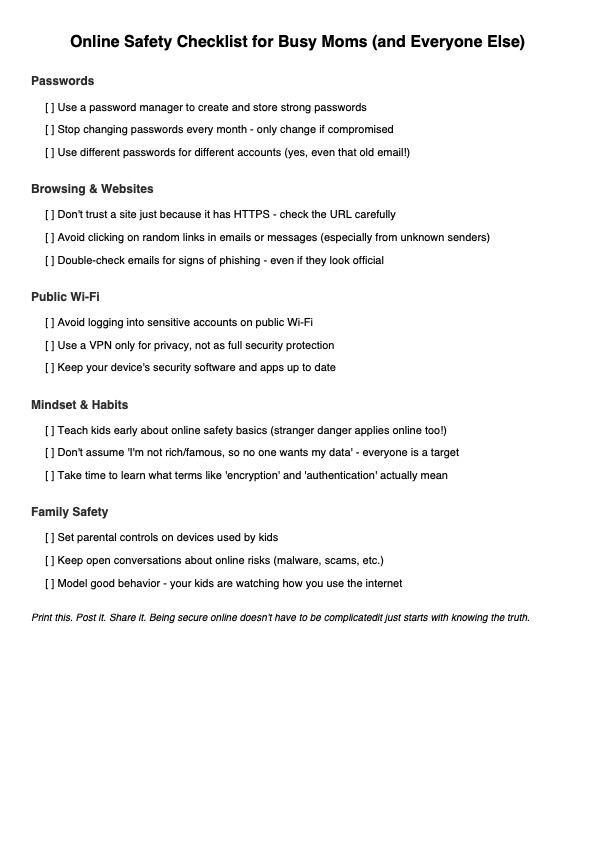
Below you’ll find a printable “Online Safety Checklist”
Source
Herbert, F., Becker, S., Schaewitz, L., Hielscher, J., Kowalewski, M., Sasse, M. A., Acar, Y., & Dürmuth, M. (2023). A world full of privacy and security (mis)conceptions? Findings of a representative survey in 12 countries. In Proceedings of the 2023 CHI Conference on Human Factors in Computing Systems (pp. 1–14). Association for Computing Machinery.
 The Carline Chronicles
Leave a comment